
⚠ This website contains flashing lights, rapid animations, and high-contrast visuals that may trigger seizures or adverse reactions in people with photosensitive epilepsy.
⚠ This website contains flashing lights, rapid animations, and high-contrast visuals that may trigger seizures or adverse reactions in people with photosensitive epilepsy.
Rlly? you wanna test us this far?
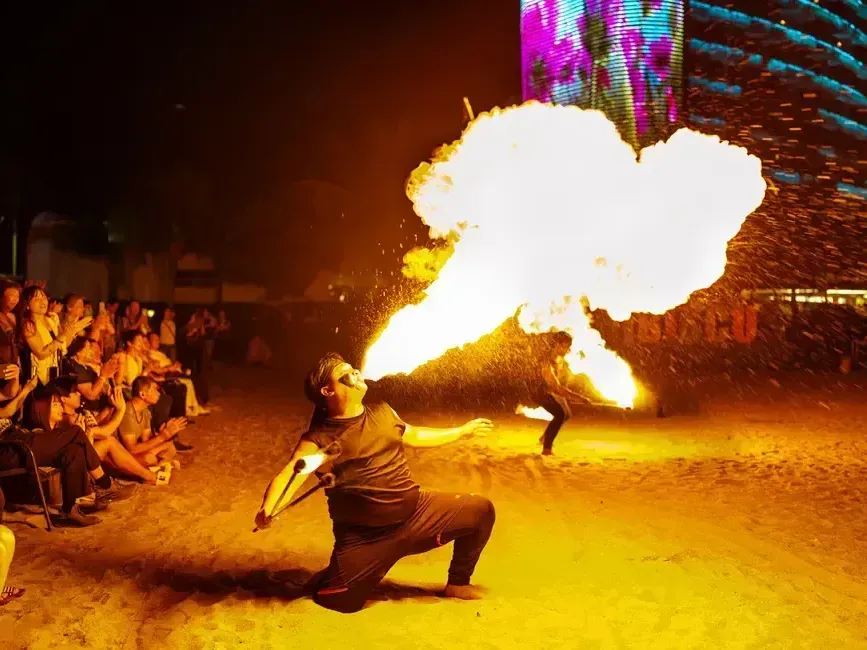
Humans have used controlled fire as a performance element for at least 5,000 years — from ancient Greek theatrical machinery to Baroque fireworks displays commissioned by European monarchies. Modern pyrotechnics has inherited this legacy and extended it with chemistry, electronics, and precision engineering that ancient practitioners could not have imagined.
The chemistry of pyrotechnics is a branch of energetic materials science that combines oxidisers, fuels, and metal salts to produce controlled exothermic reactions with specific colours, temperatures, durations, and noise profiles. The colour of a pyrotechnic effect is determined by the metal salt used: strontium compounds produce red, barium produces green, copper produces blue, sodium produces yellow. Achieving a specific shade requires precise stoichiometric ratios and particle sizes — pyrotechnics is as much analytical chemistry as it is performance art.
Modern professional pyrotechnics has layered electronics over this chemical foundation: computer-controlled firing systems allow sequences to be choreographed to the millisecond, synchronised with music, lighting, and video through MIDI or DMX timecode. The precision achievable today — firing effects within a 10-millisecond window of a musical beat — would have been incomprehensible to the cannonball-and-fuse practitioners of the 18th century.
The risk management science has evolved in parallel with the creative capabilities. Modern pyrotechnic design begins with hazard analysis: calculating blast radii, debris patterns, thermal radiation distances, and ignition risks for every material in proximity to the effect. The choreographic precision of a professional pyrotechnic sequence is matched by an equally precise safety envelope — each effect positioned, timed, and sized within margins that account for environmental variables like wind, humidity, and audience proximity.
What has not changed across five thousand years of fire as performance is the fundamental human response: immediate, visceral, and impossible to replicate with any other medium. No LED lighting rig, no projection mapping system, no pyrotechnic simulation produces the same physiological response as actual combustion — the heat, the smell, the randomness within the control. Fire is the one creative medium that is irreducibly real in an increasingly simulated world, which is precisely why its power in live performance has not diminished as production technology has advanced.

Take control of creativity, tech and scale
confidently in the new age
Take control of creativity, tech and scale
confidently in the new age

© 2026 Digital Control. All Rights Reserved.
Digital Control is a registered subsidiary of Digital Blacksheep Ventures (Private) Limited.